Home > Blog > Paint Refinishing > Why Ferrari Paint Cleanrooms Matter During Refinishing
Share this post:
Quick Takeaways
- Downdraft airflow: Vertical extraction removes airborne contaminants before they settle into fresh clearcoat
- Positive-pressure cleanrooms: Active cabin pressurization pushes outside shop air away during spray cycles
- Atmospheric stability: Strict temperature and humidity regulation ensures predictable waterborne evaporation and gloss consistency
- Non-ferrous isolation: Dedicated environments protect aluminum and carbon fiber from microscopic steel contamination
Table of Contents
Why does Ferrari refinishing require controlled environments?
Ferrari paint refinishing requires controlled environments because modern Ferrari finishes depend on tightly regulated airflow, contamination control, thermal stability, and curing consistency to achieve factory-level surface quality. Downdraft booth systems, positive-pressure cleanrooms, and calibrated curing environments prevent airborne contamination, gloss inconsistency, texture distortion, and long-term finish defects.
The Standard For Ferrari Paint Refinishing
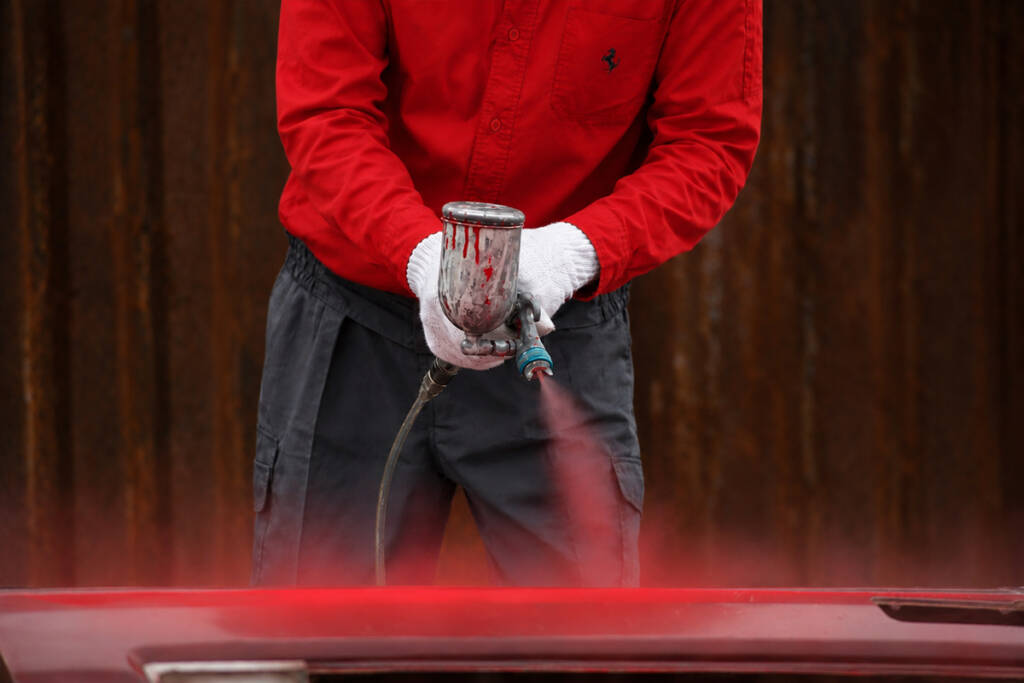
Maranello finishes are defined by absolute optical clarity, liquid-smooth surface uniformity, and precise millimeter-level paint depth. Replicating that during a refinish isn’t just a matter of technician skill — it’s dictated by the physics of the environment.
Every variable — the direction of air moving over the panels, the invisible humidity in the room — must be mechanically regulated. A factory-level finish cannot coexist with the ambient conditions of a standard repair shop.
The Danger Of Airborne Contamination
THE THREAT INSIDE EVERY STANDARD SHOP
The air in an open or poorly sealed environment carries invisible hazards — clothing fibers, sanding dust, skin cells, ambient overspray. A single particle settling into wet clearcoat creates a ‘nib’ defect. Fixing it requires compounding and polishing that permanently shears down the protective clearcoat thickness.
Advanced cleanrooms use multi-stage ceiling filtration capable of trapping particles down to 5 microns — ensuring booth air is entirely sterile before the first coat is sprayed.
How Downdraft Airflow Systems Work
Traditional crossdraft booths pull air horizontally, dragging overspray and floor dust across wet panels. Downdraft systems work on an entirely different principle.
| Standard booth | Downdraft system |
| Horizontal airflow across panels | Clean air enters through ceiling |
| Overspray drifts laterally | Vertical column sweeps downward |
| Floor dust contaminates wet surface | Airflow pulls contaminants into floor extraction |
| Exhaust exits through wall/floor mix points | Exhaust exits through floor grates |
| Door opening disrupts airflow balance | Positive pressure stabilizes internal environment |
The positive-pressure effect is critical — the booth maintains higher internal air pressure than the surrounding shop. When a technician opens the door, air rushes outward, preventing unfiltered shop air from entering.
Temperature & Humidity Stability
Paint chemistry behaves differently depending on the ambient climate. Cold environments cause poor flow and surface irregularities. Excessive heat causes solvents to flash off too quickly, locking in rough texture before the coating can level.
0–75°F
Factory-controlled booth temperature — maintained with tightly regulated humidity curves throughout every coat
This atmospheric stability allows basecoats and clearcoats to level uniformly — ensuring a refinished door matches the undisturbed factory paint on the adjacent quarter panel exactly.
Non-Ferrous Isolation
Modern Ferrari platforms rely on aluminum and carbon fiber substrates. The refinishing environment must be completely isolated from steel repair spaces.
The threat — Airborne steel dust from nearby grinding settles on exposed aluminum. With any ambient moisture, it triggers an electrochemical reaction that corrodes the metal from underneath — causing structural blistering and paint failure long after the repair appears complete.
The solution — Certified refinishing occurs in an isolated non-ferrous cleanroom where steel dust is strictly forbidden — environmental isolation isn’t a precaution. It’s the prerequisite for materials that demand it.
Waterborne Coatings & Controlled Evaporation
Premium refinishing uses waterborne basecoats — the same specification Ferrari uses at the factory. Unlike solvent-based paints, water evaporates far slower and less predictably. The environment must force evaporation mechanically.
By precisely manipulating humidity and airflow speed, technicians control the evaporation curve completely, preventing the trapped moisture that would otherwise cause cloudiness or loss of depth — one of the more consequential ways waterborne Ferrari paint systems differ from traditional automotive coatings.
Infrared Curing & Gloss Stabilization
The curing stage determines long-term durability and gloss retention. Generic bake cycles apply heat unevenly, causing clearcoat to shrink over time and distorting the finish texture.
| Method | What it produces |
| Generic bake cycle | Uneven heat distribution → clearcoat shrinkage → texture distortion over time |
| Infrared curing | Base-up heating → gas release → uniform molecular cross-linking → locked-in gloss |
Short-wave infrared waves pass through the wet clearcoat to heat the substrate first, curing from the inside out. Residual gases escape cleanly without causing pinholes — permanently locking in the deep factory gloss.
Lighting Tunnels & Visual Defect Verification
Standard fluorescent shop lighting easily hides surface flaws that become obvious in real-world conditions. The final phase uses a dedicated inspection tunnel.
01
High-CRI LED arrays
Replicates natural noon sunlight to reveal micro-scratches invisible under standard lighting
02
Diffuse soft-boxes
Eliminates harsh reflections to analyze panel texture uniformity across the entire surface
03
Monochromatic light
Isolates clearcoat depth and catches microscopic dust particles or surface contamination
Together they confirm the refinished surface looks as flawless under direct sunlight as it does under showroom lighting — the same standard of factory color depth and texture the car left the factory with.
FAQS About Refinishing Environments
Can a standard body shop achieve a factory Ferrari finish?
Without micron filtration, vertical downdraft booths, and isolated aluminum zones, contamination risk makes a true factory finish nearly impossible.
Why does aluminum need a separate refinishing environment?
Airborne steel dust causes galvanic corrosion — a hidden chemical reaction that corrodes aluminum from underneath, eventually blistering the finish.
What's the advantage of positive-pressure paint booths?
Air pressure pushes outward when doors open, actively blocking dust and debris from reaching wet clearcoat.
Why is infrared curing better than a standard bake cycle?
Infrared heats the substrate first, curing paint inside-out. Gases escape cleanly, preventing pinholes and locking in factory gloss.
Why do waterborne coatings need controlled evaporation?
Water evaporates slower and less predictably than solvents — without controlled airflow between coats, trapped moisture causes cloudiness and depth loss.
Preserving Ferrari Finish Integrity
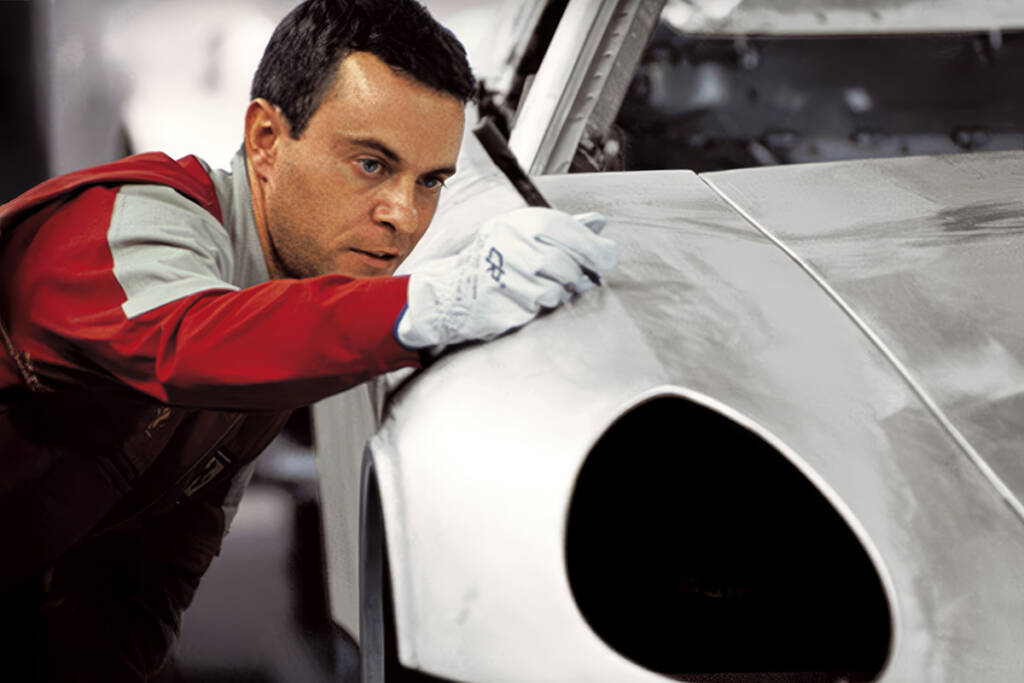
At the highest level of automotive restoration, a paint booth is a precisely calibrated piece of industrial engineering.
Controlling airflow dynamics, isolating metal substrates, and normalizing ambient variables eliminates guesswork from the refinishing equation — the only way to truly honor the design, value, and lasting visual heritage of your Ferrari.
REPAIR INSIGHTS