Home > Blog > Aluminum Repair > Ferrari Carbon Fiber vs Aluminum Repairs
Share this post:
Quick Takeaways
- Carbon fiber repair relies on resin bonding and controlled curing.
- Ferrari aluminum restoration requires isolated cleanroom environments.
- Composite fractures often require ultrasonic scanning.
- Carbon fiber and aluminum require electrical isolation barriers.
Table of Contents
Carbon Fiber vs Aluminum Repairs
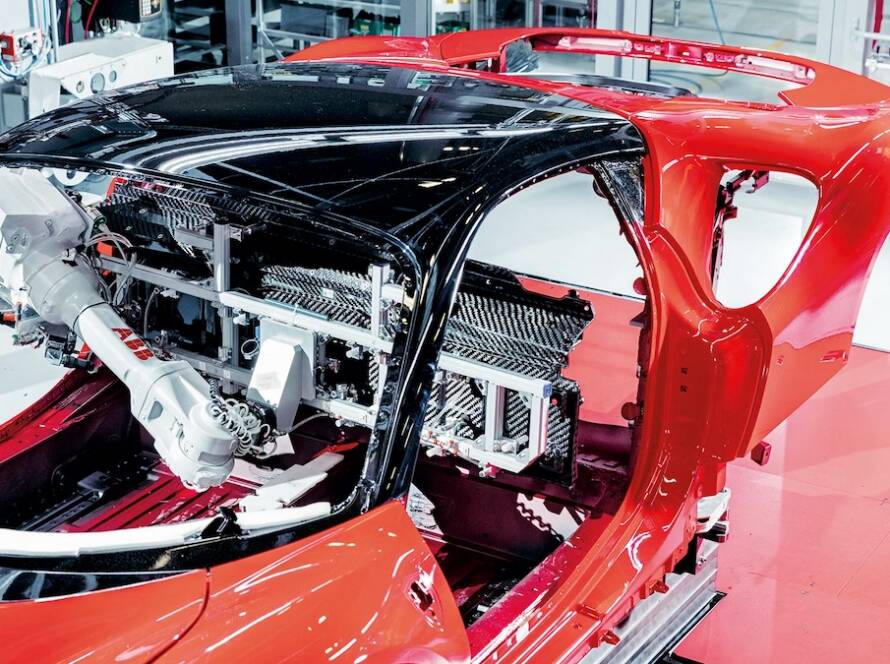
Ferrari carbon fiber repairs differ fundamentally from aluminum because composite structures can’t be reshaped or thermally corrected like metal.
Aluminum relies on precision calibration and specialized joining procedures. Carbon fiber requires resin bonding, ultrasonic inspection, controlled curing — and in many cases, complete replacement.
Why Ferrari Uses Both Carbon Fiber and Aluminum
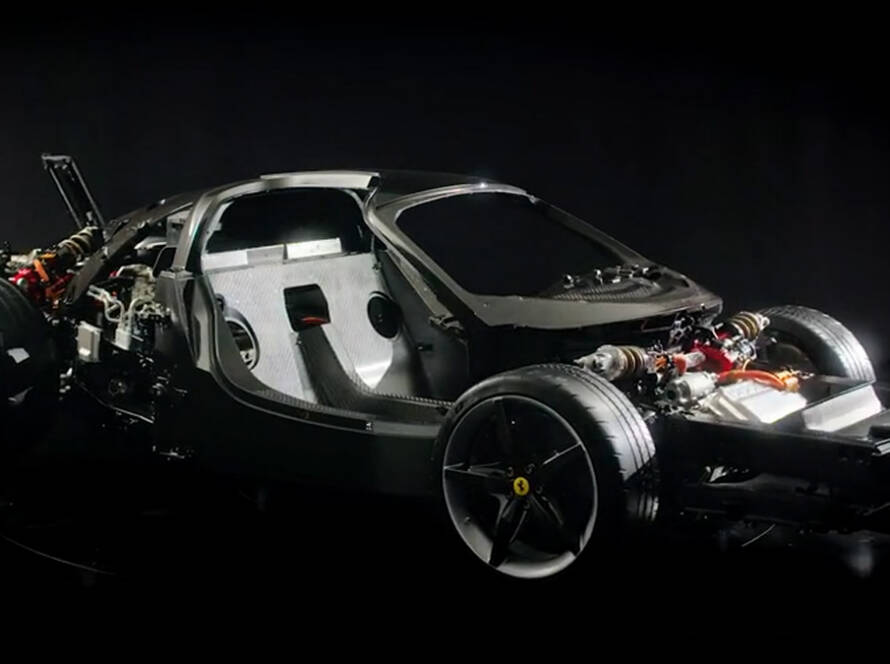
Modern Ferrari platforms combine carbon fiber and aluminum to balance rigidity, crash management, and aerodynamic efficiency.
Ferrari engineers strategically utilize:
- Carbon fiber — lightweight reinforcement and chassis stiffness
- Aluminum — energy absorption and structural load management
- Hybrid architecture — performance balance across the platform
Each material is placed where its specific properties do the most work.
Understanding Ferrari Carbon Fiber Structures
Composite Components
| Carbon Fiber Area | Primary Function |
|---|---|
| Monocoque tubs | ●Chassis Stiffness |
| Roof assemblies | ●Weight reduction |
| Rear bulkheads | ●Torsional support |
| Aero components | ●Downforce management |
Carbon fiber is anisotropic — meaning its strength characteristics change depending on fiber orientation and weave direction. This makes damage assessment and repair far more complex than with metal.
Understanding Ferrari Aluminum Space-Frames
Ferrari aluminum structures manage impact forces through engineered load paths — not just physical mass.
Three distinct structural types are involved:
- Castings — suspension nodes and impact zones
- Extrusions — multi-hollow beams forming the rigid foundation
- Outer sheet structures — lightweight aerodynamic panels
Each responds differently to collision forces, and each requires a different restoration approach.
Carbon Fiber vs Aluminum Comparison
| Attribute | Carbon Fiber | Aluminum |
|---|---|---|
| Primary Method | ●Composite bonding | ●Precision calibration |
| Heat Tolerance | ●Extremely limited | ●Controlled tolerance |
| Damage Visibility | ●Often hidden internally | ●More measurable |
| Joining Methods | ●Resin bonding | ●SPR & adhesives |
| Corrosion Exposure | ●Delamination risk | ●Galvanic corrosion |
| Calibration Needs | ●Critical | ●Critical |
Why Carbon Fiber Damage Is Difficult to Detect
Exterior paint and clear coat can look completely intact while the composite structure beneath is compromised.
Hidden damage may include:
- Internal Delamination
- Resin Fractures
- Layer Separation
- Microscopic Fiber Separation
Factory-authorized facilities use ultrasonic scanning and acoustic testing to map hidden damage before any repair work begins.
How Ferrari Carbon Fiber Repairs Are Performed
Composite repair follows a precise sequence — there’s no shortcutting the process:
- Component Disassembly
- Composite Inspection
- Ultrasonic Damage Mapping
- Resin Preparation
- Layer Reconstruction
- Vacuum Curing
- Final Validation
Unlike metal, certain Ferrari carbon fiber assemblies can’t be corrected locally. High-load modules often require complete replacement.
Why Aluminum Requires Isolated Environments
Ferrari aluminum work must take place inside physically isolated, non-ferrous environments.
Composite Components
| Environmental Risk | Potential Consequence |
|---|---|
| Steel contamination | ●Galvanic corrosion |
| Excessive heat exposure | ●Metallurgical weakening |
| Uncontrolled temperatures | ●Dimensional variance |
| Shared grinding areas | ●Long-term corrosion |
Even microscopic steel contamination can compromise aluminum integrity long after the repair appears complete.
How Material Choice Affects Collision Costs
Repair complexity on a Ferrari is often determined less by visible damage and more by what’s happening beneath the surface.
Major cost factors:
- Composite reconstruction — vacuum curing, resin preparation, layered rebuilding
- Structural calibration — fixture systems and dimensional verification
- OEM components — factory-serialized replacement parts
- Specialized labor — composite technicians, calibration specialists, non-ferrous environments
Carbon fiber work is typically more involved than aluminum exterior repair — largely because of the inspection and curing requirements.
Why Structural Calibration Matters
Regardless of material, Ferrari platforms require exact dimensional tolerances to perform as engineered.
Calibration systems used include:
- Car Bench fixture systems
- Celette calibration tables
- ADAS recalibration arrays
- Dimensional verification scanning
Both carbon fiber and aluminum reconstruction require dimensional verification after correction — this step isn’t optional on either material.
FAQs About Ferrari Carbon Fiber & Aluminum Repairs
Can carbon fiber be repaired after a collision?
Certain composite sections may be restorable, while high-load carbon modules often require full replacement.
Why is hidden carbon fiber damage dangerous?
Internal delamination may weaken chassis integrity without visible exterior damage.
Why do aluminum procedures require isolated cleanrooms?
Isolated environments help prevent steel contamination and galvanic corrosion.
What is galvanic corrosion?
Galvanic corrosion occurs when conductive materials create electrochemical deterioration between metal surfaces.
Do both materials require dimensional calibration?
Yes. Both aluminum and carbon fiber reconstruction procedures require precise dimensional verification after correction.
Are carbon fiber procedures more expensive than aluminum work?
In many cases, yes. Composite reconstruction and curing operations are often more complex than metallic refinishing and panel correction.
Preserving Ferrari Performance
Carbon fiber and aluminum behave very differently in a collision — and they require entirely different restoration approaches.
Specialized inspection methods, bonding techniques, and calibration standards aren't optional on these platforms. They're what separates a true Ferrari restoration from a conventional repair.
Learn more about our Ferrari aluminum restoration procedures and factory-guided standards.
REPAIR INSIGHTS