Home > Blog > Collision Repair > Why Ferrari ADAS Systems Require Recalibration After Collision Repair
Share this post:
Quick Takeaways
- Small shifts matter. Even a minor change in radar or camera alignment can affect how a Ferrari’s driver assistance systems read the road.
- Paint can blind a sensor. Extra layers of primer or paint over a bumper-mounted radar module can block its signal entirely.
- Multi-brand tools won’t cut it. Recalibration requires factory-authorized diagnostic platforms and physical target benches — equipment most body shops simply don’t own.
Table of Contents
What Is Ferrari ADAS?
Ferrari Advanced Driver Assistance Systems (ADAS) are a network of cameras, radar units, ultrasonic sensors, and software that help monitor the road and support safer driving. Depending on the model, these systems can include:
- Adaptive Cruise Control
- Automatic Emergency Braking
- Blind Spot Monitoring
- Lane Departure Warning
- Parking Sensors & Surround View Cameras
- Traffic Sign Recognition
Each feature relies on sensors being positioned exactly where Ferrari engineered them. Even a minor shift during collision repair can affect their accuracy, making recalibration an essential part of the restoration process.
Why Do Ferrari ADAS Systems Require Recalibration?
Impacts, structural repairs, panel removal, even repainting — all of it can shift the factory mounting angle of radar sensors and cameras. Even a small shift can affect Adaptive Cruise Control, Automatic Emergency Braking, and Blind Spot Monitoring.
Recalibration resets these systems to factory reference values using specialized diagnostic equipment and calibration targets.
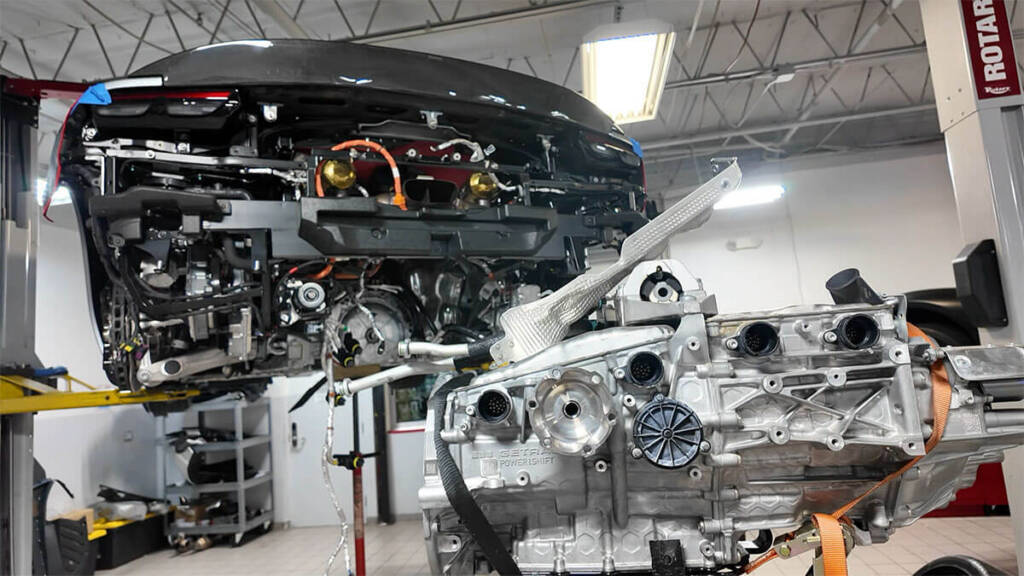
Where Ferrari ADAS Sensors Are Located
Modern Ferraris rely on a network of cameras, radar units, and ultrasonic sensors positioned throughout the vehicle:
- Front windshield — Forward-facing camera. Handles lane assist, sign recognition.
- Headlights & bumpers — Ultrasonic sensors. Handle parking & proximity alerts.
- Front grille — Long-range radar. Handles adaptive cruise, emergency braking.
- Rear quarter panels — Sub-surface radar. Handles blind spot monitoring.
How It All Works Together
Radar units measure the distance and speed of surrounding vehicles. Optical cameras track lane markings, signage, and pedestrians. Steering and inertial sensors cross-check the driver’s actual inputs against radar data, so interventions only fire during a genuine emergency.
These sensors continuously communicate with the vehicle’s onboard control systems, helping ensure driver assistance features respond accurately to changing road conditions.
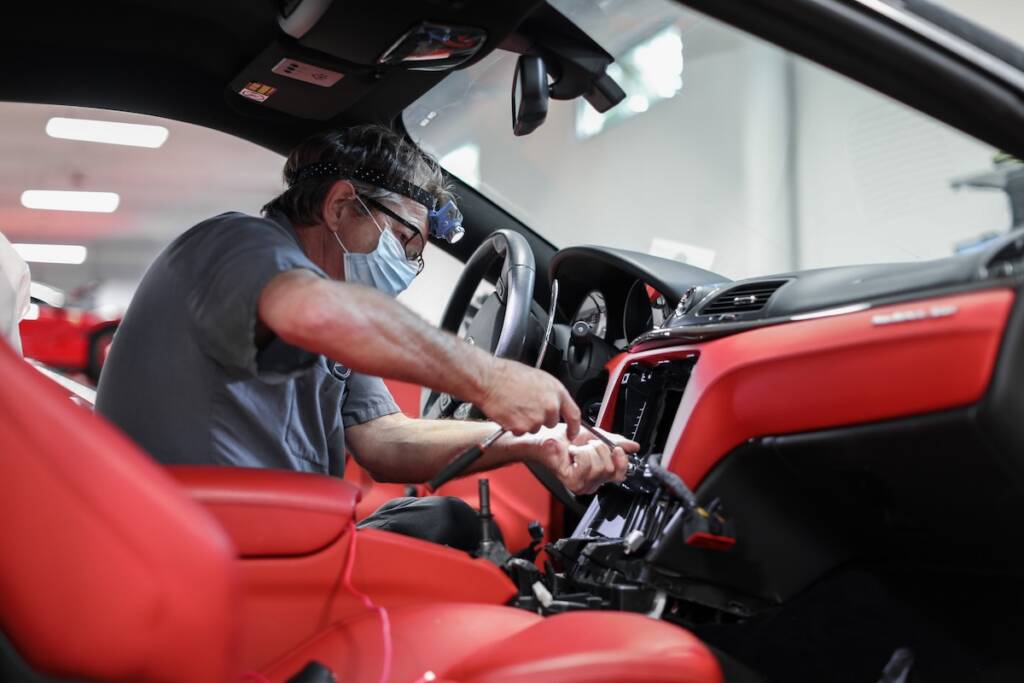
Why Minor Collision Repair Disturbs Sensitive Sensors
Here’s the part most owners don’t expect: a sensor doesn’t need to be hit to need recalibration. Structural components behave like a row of dominoes — an impact at one corner can shift brackets across the entire front clip, even where nothing looks damaged.
A few common repair steps show why:
- Front bumper replacement — May affect front radar alignment.
- Windshield replacement — Alters forward-facing camera position.
- Wheel alignment — Changes vehicle geometry used by ADAS.
- Structural repairs — Can shift sensor mounting locations.
- Camera replacement — Requires factory calibration.
- Radar bracket replacement — Restores sensor reference angle.
Why Paint Thickness Matters
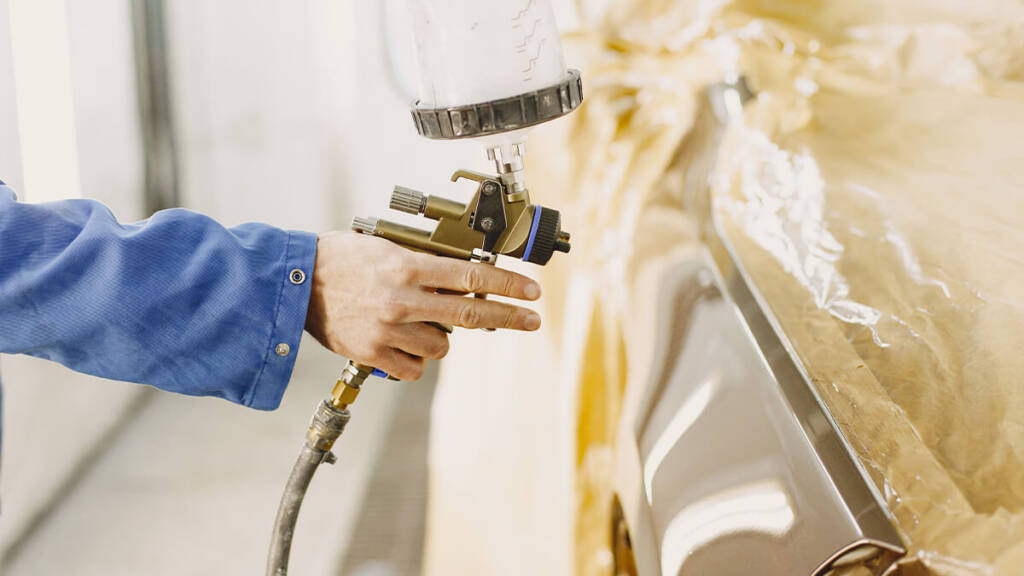
Unlike visible light, radar signals must pass through the bumper cover to detect surrounding vehicles. Excessive filler, primer, or paint can weaken that signal, which is why Ferrari-approved refinishing procedures carefully control paint film thickness during every repair.
Ferrari’s bumper covers are variable-thickness composite panels finished in multi-stage luxury paint, not the thin, uniform covers found on a mass-market car. That’s why proper shops measure paint film thickness with ultrasonic gauges during a repair — not just to match color, but to keep the radar signal clean enough to work.
The Calibration Process: Two Phases, Not One
Restoring ADAS accuracy happens in two stages:
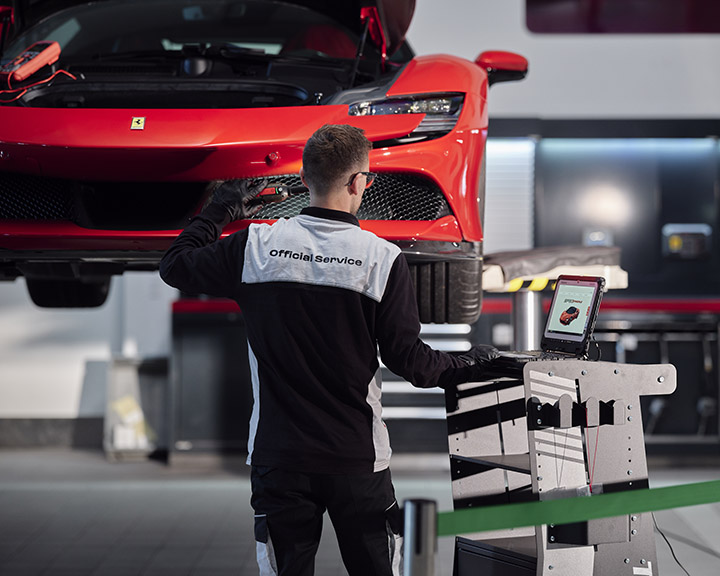
- Static calibration — inside a climate-controlled bay, a factory-authorized laser target system is aligned to the car’s centerline. The onboard control modules compare each sensor against these precisely positioned targets to restore factory reference values.
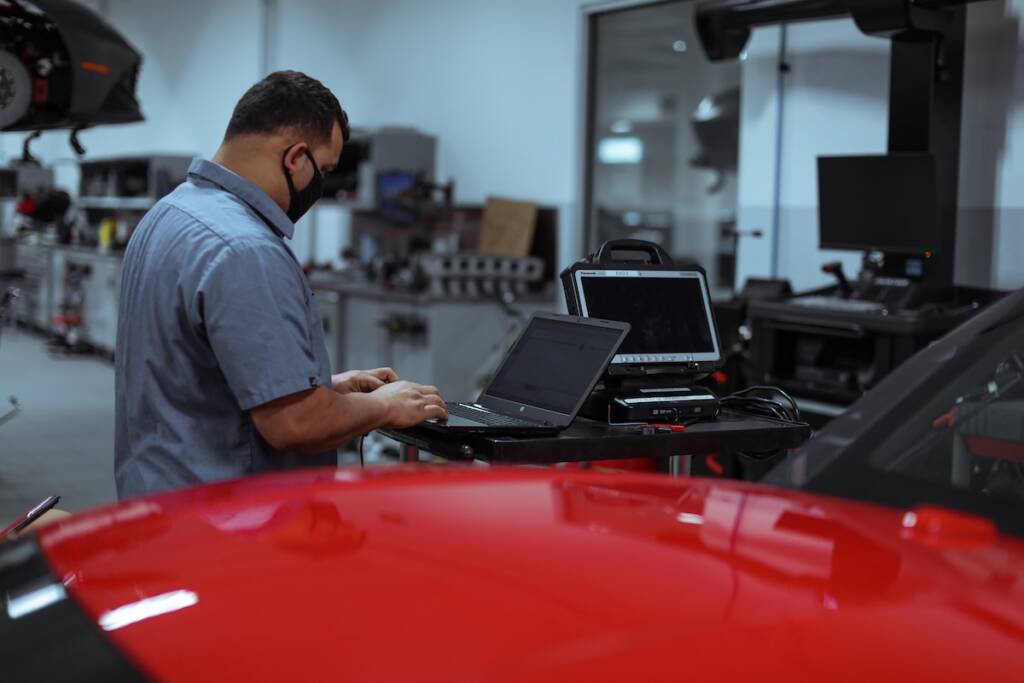
- Dynamic calibration — the car is then driven a specific route with a factory diagnostic tool connected via OBD-II, mapping real lane lines and traffic to fine-tune tracking. Calibration is only complete once the software confirms repeatable, precise object tracking.
Why Generic Scan Tools Can't Do This Job
Most collision centers rely on generic, multi-brand scan tools that can clear a basic engine code but can’t touch the proprietary protocols inside a Ferrari’s control modules.
Without factory-level access, a shop can reset a warning light without ever fixing the underlying misalignment — leaving the dashboard clean while the actual safety system stays offline.
FAQs About ADAS Recalibration
Can a standard body shop calibrate my Ferrari's sensors?
No. General shops use multi-brand tools that lack the proprietary software access required to communicate with Ferrari’s advanced network.
Will a small bumper scratch repair require an ADAS calibration?
Yes. Removing the bumper fascia to paint it alters the factory mounting tolerances of the hidden radar units beneath it.
What happens if my Ferrari's ADAS is not properly calibrated?
Your vehicle may display dashboard warning lights, deactivate safety features, or trigger unexpected autonomous emergency braking interventions due to skewed data.
Can I drive my Ferrari before ADAS recalibration?
Your Ferrari may still be drivable, but driver assistance features may be limited or unavailable until ADAS calibration is completed.
How does paint thickness affect Ferrari radar performance?
Excessive layers of primer, paint, or clear coat over a sensor blind the module by blocking the returning electromagnetic waves.
Does windshield replacement trigger a camera calibration?
Yes. New glass subtly shifts the pitch and alignment of the rearview-mirror camera, making a static target recalibration mandatory.
Securing Safety and Value at Ferrari Coachworks
At Ferrari Coachworks, structural craftsmanship and factory-authorized ADAS recalibration go hand in hand, because restoring a Ferrari means more than repairing visible damage—it means ensuring every structural, electronic, and safety system performs exactly as Ferrari intended.
Learn more about our collision repair services or contact Ferrari Coachworks to discuss your vehicle's restoration.
REPAIR INSIGHTS