Home > Blog > Bench Jig System > How Ferrari Chassis Alignment Affects High-Speed Stability
Share this post:
Quick Takeaways
- Alignment directly controls steering precision, suspension tracking, and high-speed stability.
- Dimensional deviations disrupt downforce profiles and active chassis-control networks.
- Collision damage introduces bump steer and tracking wander only detectable at speed.
- Factory blueprint calibration — not generic optical alignment — is the only valid correction method.
Table of Contents
How does Ferrari chassis alignment affect high-speed stability?
Ferrari chassis alignment affects high-speed stability because the platform is engineered around precise suspension geometry, aerodynamic balance, and millimeter-exact tolerances.
Even small deviations alter steering response, tire loading, and tracking behavior under aerodynamic pressure. Only factory calibration systems restore the original handling characteristics.
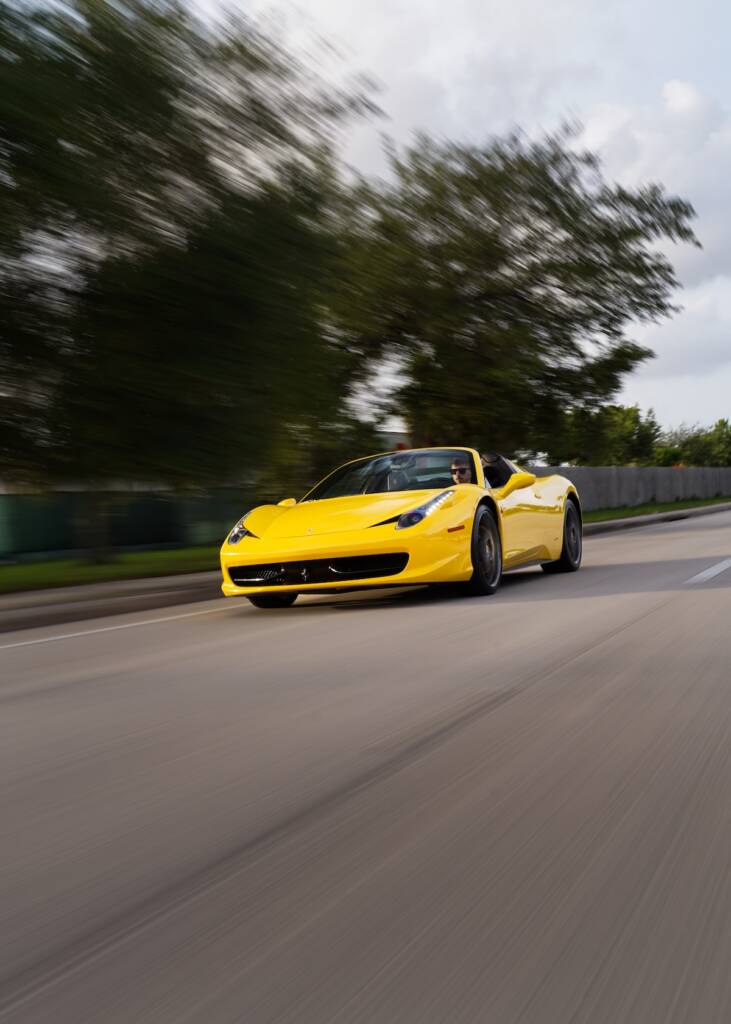
Why Ferrari Stability Depends On Precise Alignment
Every control arm angle, bushing offset, and subframe placement is calibrated to manage massive mechanical and aerodynamic forces. A Ferrari doesn’t treat alignment as a tire-wear metric — it’s a fundamental handling vector.
When the platform shifts by even a fraction of a degree, the entire dynamic load path changes — making Ferrari structural measurement procedures the baseline for any valid restoration.
How Small Deviations Affect Handling
A Ferrari may appear dimensionally correct while stationary, yet behave entirely differently once aerodynamic load compresses the suspension at speed.
High-speed tracking instability
Continuous lateral drift requiring constant steering correction on straights.
Unpredictable yaw response
Vehicle rotates more aggressively in one direction than the other.
Reduced corner-entry predictability
Delay or loss of clarity when initiating turn-in under front-axle load.
Directional inconsistency under load
Unprompted heading change when transitioning from acceleration to hard braking.
Steering, Suspension Geometry & Tire Contact
A deflected suspension mounting node — even slightly — produces dynamic alignment errors invisible until the suspension compresses at speed.
Bump steer
An uncalibrated pick-up point forces the wheel to steer itself inward or outward under downforce compression — without driver input.
Dynamic toe fluctuations
Front and rear axles continuously dispute the line of travel, creating high-speed tracking wander.
Uneven tire loading
Tracking angles flexing out of parameter reduce contact patch pressure distribution and absolute mechanical grip.
Why Aerodynamics Depend On Dimensional Accuracy
Underbody airflow, venturi tunnels, and rear diffusers require an uncompromised ride height and rake angle. Any geometric deviation corrupts the data feeding the car’s active systems.
| SSC calibration | Side Slip Control maps E-Diff and traction algorithms from yaw, pitch, and roll data — alignment errors corrupt those inputs. |
| Active aero | Geometric deviation triggers incorrect deployment of underbody flaps and aerodynamic surfaces. |
| System error | Electronics misread structural tracking error as a tire slide — incorrectly activating brake vectoring or adaptive damping. |
How Collision Damage Alters Stability
The most dangerous damage isn’t visible. It’s a sequence that only reveals itself at speed.
- Impact travels through aluminum castings and extrusions, shifting suspension nodes out of position.
- Static check passes — standard optical alignment shows acceptable parameters.
- Downforce compresses the suspension at speed, exposing hidden geometric deviations.
- Bump steer triggers — altered geometry forces unintended toe changes.
- Handling degrades — directional inconsistency under load reduces driver confidence and safety.
The material that absorbs and distributes that initial impact — whether aluminum or carbon fiber — determines how the damage spreads, which is why Ferrari carbon fiber vs aluminum repair procedures differ fundamentally from each other.
Why Factory Calibration Matters
Standard alignment systems calibrate to a regional average baseline — they can’t validate Ferrari’s core architecture.
THE ONLY VALID CORRECTION METHOD
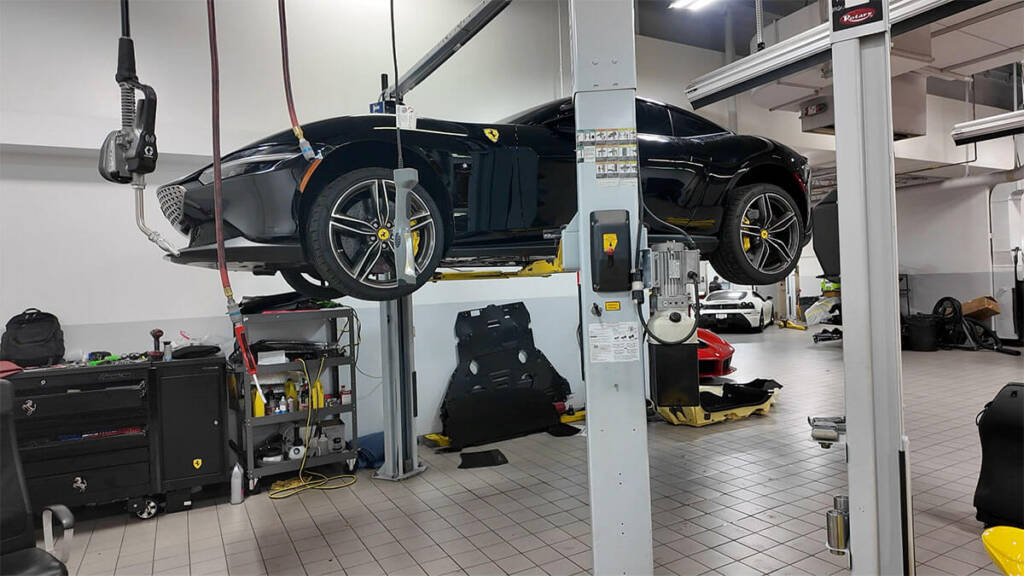
Car Bench or Celette fixture systems mechanically anchor the space-frame to factory reference datums, identifying hidden structural movement to fractions of a millimeter — rebuilding the wheel tracking and sensor baselines active systems depend on.
See exactly how specialized bench jig systems achieve this at every stage of restoration.
FAQS About Ferrari Chassis Stability
Why can a Ferrari pass alignment checks but feel unstable?
Static equipment can’t detect subsurface casting deflection. The problem only emerges when downforce compresses the suspension at speed — by which point the car is already behaving unpredictably.
What causes high-speed tracking instability after a collision?
Microscopic movements in suspension pickup points introduce dynamic toe changes that cause the car to steer itself under aerodynamic pressure — undetectable until performance speeds.
How do chassis deviations affect active aerodynamics?
Altered geometry distorts yaw and pitch sensor data, causing the vehicle’s electronics to deploy active flaps or brake vectoring incorrectly — compounding the instability.
Can improper alignment affect Side Slip Control (SSC)?
Yes. Inaccurate geometry corrupts wheel speed and yaw metrics, causing the electronic differential and stability mapping to react unpredictably.
Why are standard frame racks inadequate for Ferrari?
Generic racks use hydraulic pulling chains that over-stretch aluminum alloys. Certified bench systems use fixed steel fixtures to calibrate geometry without material stress.
Verifying Dynamic Performance Compliance
True Ferrari alignment verification requires mechanical geometry validation under performance-level simulation — not static estimation.
A facility with vehicle-specific fixture tables is the only way to confirm your car's structural backbone is fully restored before it returns to the road.
REPAIR INSIGHTS