Home > Blog > Aluminum Repair > Carbon Fiber vs Aluminum: What Changes When a Car Needs Repair
Share this post:
Quick Takeaways
- Carbon fiber is lighter and stiffer. But it cracks instead of bending, so damage behaves differently.
- Carbon damage hides under the paint. Internal layers can separate with no visible sign on the surface.
- Carbon is rebuilt, not reshaped. Repairs use resin, new fiber layers, and controlled curing, or full replacement.
- The two materials must be kept apart. Carbon touching bare aluminum can cause corrosion.
Table of Contents
Carbon fiber and aluminum are repaired in completely different ways. Damaged aluminum can often be reshaped and joined with rivets and adhesives, while damaged carbon fiber has to be rebuilt layer by layer with resin or replaced entirely.
Many supercars use both. That means one collision can call for two very different repair processes, plus extra care where the materials meet, all as part of a proper luxury car collision repair.
Is Carbon Fiber Stronger Than Aluminum?
For its weight, yes. Carbon fiber is roughly 40% lighter than aluminum and far stiffer, which is why it shows up on supercars and race cars.
But the two fail differently. Aluminum bends and dents when it’s hit, so damage is usually visible and measurable. Carbon fiber holds its shape until it cracks or splits apart internally. That difference drives everything about how each one is repaired.

Why Exotic Cars Use Both
High-end cars put each material where it works best:
- Carbon fiber: stiffness and light weight, in tubs, roofs, and aero parts
- Aluminum: absorbing crash energy and carrying loads, in rails and crash structures
- Hybrid designs: both combined, so the car is light, stiff, and safe in a crash
McLaren builds every car around a carbon tub, and cars like the Lamborghini Revuelto and Ferrari’s F80 use carbon chassis. Most Ferraris use aluminum frames with carbon in key areas.
Where Carbon Fiber Is Used on a Car
| Carbon Fiber Part | What It Does |
|---|---|
| Monocoque tub | ●Forms the stiff central chassis |
| Roof and pillars | ●Cuts weight up high for better handling |
| Rear bulkhead | ●Adds twisting stiffness behind the cabin |
| Aero parts | ●Splitters, diffusers, and wings that create downforce |
Carbon fiber’s strength depends on direction. Each layer is laid with its fibers pointing a certain way, so a repair has to rebuild those layers in the same order and direction to restore the original strength.

How Aluminum Fits In
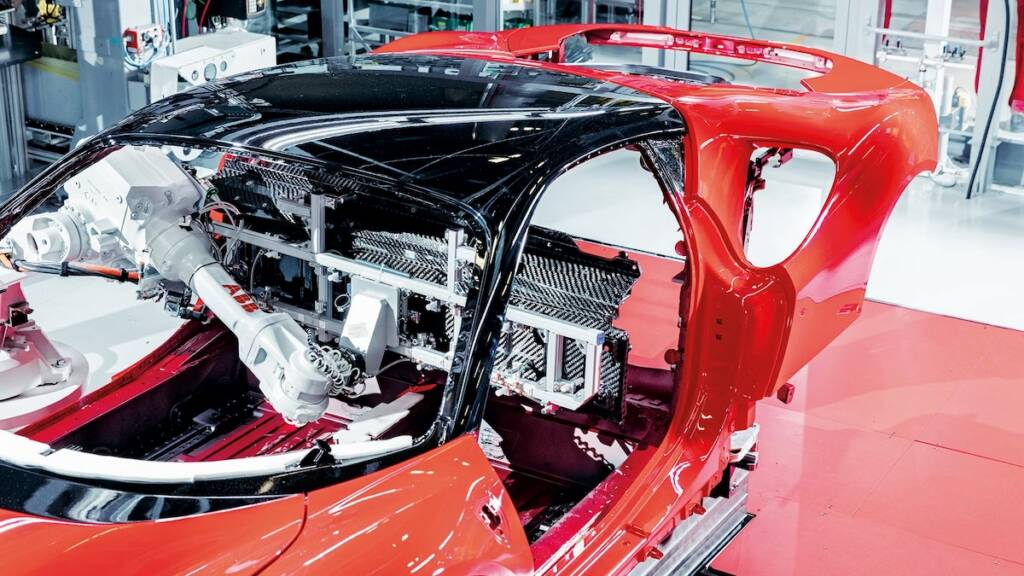
Ferrari aluminum structures manage impact forces through engineered load paths — not just physical mass.
Three distinct structural types are involved:
- Castings — suspension nodes and impact zones
- Extrusions — multi-hollow beams forming the rigid foundation
- Outer sheet structures — lightweight aerodynamic panels
Carbon Fiber vs Aluminum Repair, Side by Side
| Factor | Carbon Fiber | Aluminum |
|---|---|---|
| How it’s repaired | ●Rebuilt with resin and new layers | ●Reshaped, riveted, and bonded |
| Heat tolerance | ●Very limited | ●Limited and tightly controlled |
| Damage visibility | ●Often hidden inside | ●Usually visible and measurable |
| Inspection | ●Ultrasonic scanning | ●Measuring against factory dimensions |
| Main long-term risk | ●Layers separating | ●Corrosion |
| When it’s replaced | ●Damage to load-bearing parts | ●Cracked castings or kinked rails |

Why Carbon Fiber Damage Is Hard to See
Carbon fiber can look perfect and still be damaged. Paint and clear coat stay intact while the layers underneath crack or separate. Hidden damage can include:
- Delamination, where layers separate from each other
- Cracks in the resin that holds the fibers together
- Broken fibers inside the part
That’s why carbon parts are checked with ultrasonic scanning before any repair is planned. It maps damage the eye can’t see.
How Carbon Fiber Car Repair Works
Composite repair follows a strict sequence:
- Remove the damaged part or expose the area
- Scan for hidden damage
- Grind away the damaged layers in a tapered pattern
- Lay new carbon fiber in the original direction and order
- Cure the resin under vacuum and controlled heat
- Inspect and refinish the surface
Not every carbon part can be repaired. Some manufacturers approve repairs to certain sections, while load-bearing parts often have to be replaced. After either material is repaired, the structure is measured against factory dimensions, the same check used in frame damage repair.
Where Carbon Fiber Meets Aluminum
Carbon fiber and aluminum can’t touch directly. Carbon conducts electricity, and with moisture present, it corrodes the aluminum it’s in contact with. That’s called galvanic corrosion.
Factory joints use barriers, such as insulating layers and sealants, to keep the two apart. A repair has to restore those barriers exactly. Aluminum also needs its own clean workspace to avoid steel contamination, which we explain in what an aluminum repair facility requires.
Why Carbon Fiber Repairs Often Cost More
Cost depends more on what’s under the surface than what you can see. The biggest factors:
- Inspection: ultrasonic scanning to map hidden carbon damage
- Rebuilding: layer-by-layer repair and vacuum curing take time
- Parts: carbon and aluminum replacements are expensive, especially OEM parts
- Labor: composite technicians and aluminum-trained techs
Carbon fiber work usually costs more than aluminum panel repair, mostly because of the inspection and curing involved.

FAQs About Ferrari Carbon Fiber & Aluminum Repairs
Is carbon fiber lighter than aluminum?
Yes. Carbon fiber is roughly 40% lighter than aluminum for a part of the same size, and it’s much stiffer.
Can carbon fiber be repaired after a collision?
Often, yes, for panels and some structural sections. Load-bearing carbon parts may need to be replaced, depending on the manufacturer’s procedures.
Why is hidden carbon fiber damage dangerous?
Internal layers can separate without any sign on the surface, weakening the part in a way you can’t see until it fails.
What is galvanic corrosion?
Corrosion that happens when two different conductive materials touch with moisture present. With carbon fiber and aluminum, the aluminum is the part that corrodes.
Is carbon fiber repair more expensive than aluminum?
Usually. Carbon repairs need ultrasonic inspection, layer-by-layer rebuilding, and controlled curing, all of which add time and cost.
Does a Ferrari have a carbon fiber chassis?
Most Ferraris use aluminum frames with carbon fiber in key areas. Hypercars like the LaFerrari and F80 are built around carbon fiber tubs.
Carbon & Aluminum
Two Materials, One Repair Done Right
Every material gets its own process. We repair carbon fiber and aluminum on luxury and exotic cars to each manufacturer's procedures as part of our collision repair.
REPAIR INSIGHTS